Is my snoring sleep apnea?
Usually not: most people who snore don't have sleep apnea. What separates the two isn't how loud the snoring is but what comes with it: pauses in breathing, choking or gasping, and feeling sleepy during the day [1][2]. The only way to know for sure is a sleep test.
Last reviewed 24 September 2026. General information from the Snorezy team, not medical advice.
Ordinary snoring
Snoring on its own is the sound of tissue in your airway vibrating [2]. It can be loud, it can annoy a partner, and it can come and go with alcohol, a cold or your sleeping position, without your breathing being interrupted.
Signs that point to sleep apnea
These are the signs worth taking to a doctor [1]:
- somebody sees you stop breathing for a while in your sleep;
- you choke, gasp or snort yourself awake;
- you feel very sleepy during the day, however long you slept;
- morning headaches, or waking at night to urinate.
A common pattern a partner describes is snoring that goes quiet, then ends in a gasp or a loud snort as breathing restarts.
What you can't tell from the sound
A quiet stretch in a recording doesn't mean breathing stopped: you may have turned over, or simply breathed quietly. Loud snoring doesn't mean apnea either. That's why diagnosis uses a sleep test that measures breathing and oxygen directly: see how sleep apnea is diagnosed.
What to do
If any of the signs above apply, talk to a doctor [2]. Bring what you know: how long it has been happening, what a partner has noticed, and how you feel in the day.
In Snorezy
Something to bring, not an answer
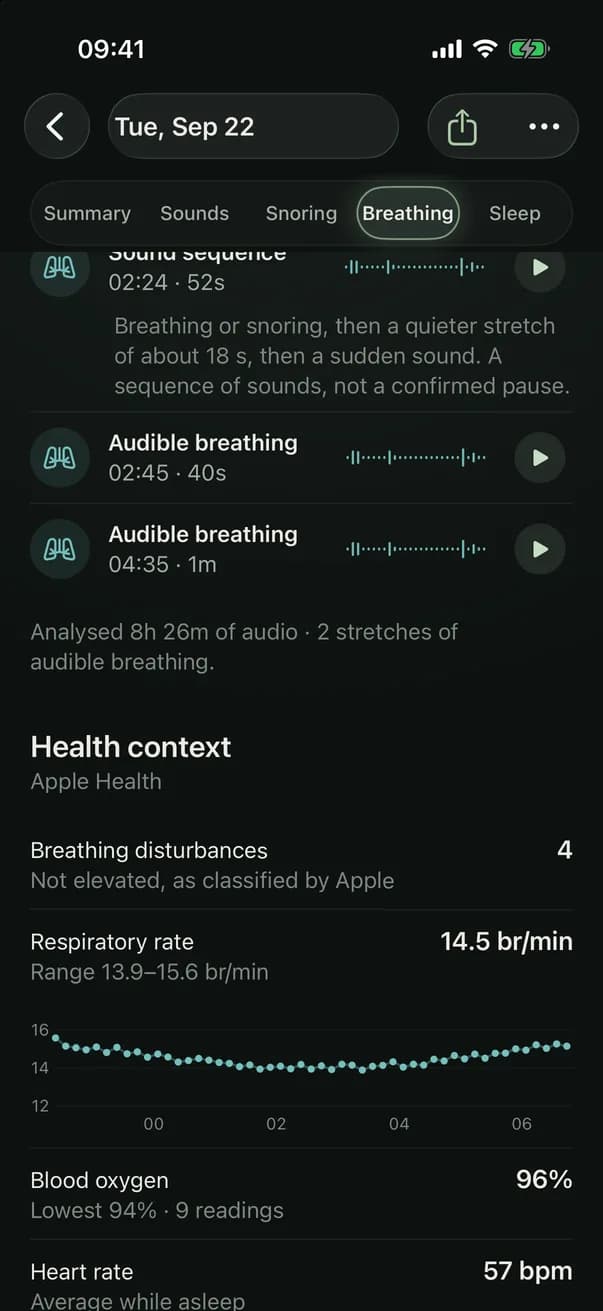
Snorezy marks breathing-related sounds to review: a gasp-like sound, audible breathing, or a sequence where snoring or breathing gives way to a quieter stretch and then a sudden sound. Each one is kept with the minute before it, so you or your doctor can hear the whole moment. The report says plainly that these recordings can't confirm or rule out sleep apnea.