
How to sleep better: what actually helps
A regular schedule, less caffeine and alcohol late in the day, and a dark, quiet bedroom are sensible basics. But be realistic about tips: for chronic insomnia, sleep medicine doesn't recommend sleep hygiene advice on its own, and recommends cognitive behavioural therapy for insomnia (CBT-I) instead [1].
Last reviewed 24 September 2026. General information from the Snorezy team, not medical advice.
The basics worth doing
- Keep a regular schedule. Similar bedtimes and wake times, including at weekends.
- Give yourself enough time. Adults should regularly get 7 hours or more [2].
- Stop caffeine early. 400 mg of caffeine taken even six hours before bed disrupted sleep in a controlled study; the authors advise avoiding substantial caffeine for at least six hours before bed [3].
- Go easy on evening alcohol. It disrupts the second half of the night [4].
- Keep the room dark and quiet. If you can't make it quiet, steady background noise can mask sudden sounds [5].
Why tips aren't a treatment
If you've had trouble sleeping for months, a list like the one above probably won't fix it, and it's not meant to. The American Academy of Sleep Medicine's guideline gives its strongest recommendation to multicomponent CBT-I, and the World Sleep Society, endorsing it, did not endorse sleep hygiene education as a treatment on its own [1]. CBT-I is available through doctors, therapists and some digital programmes.
Find out what's actually disturbing you
General advice is general. What wakes you might be a partner's snoring, a street, your own breathing, or nothing you can hear at all. Knowing which is more useful than any tip.
In Snorezy
Test it on your own nights
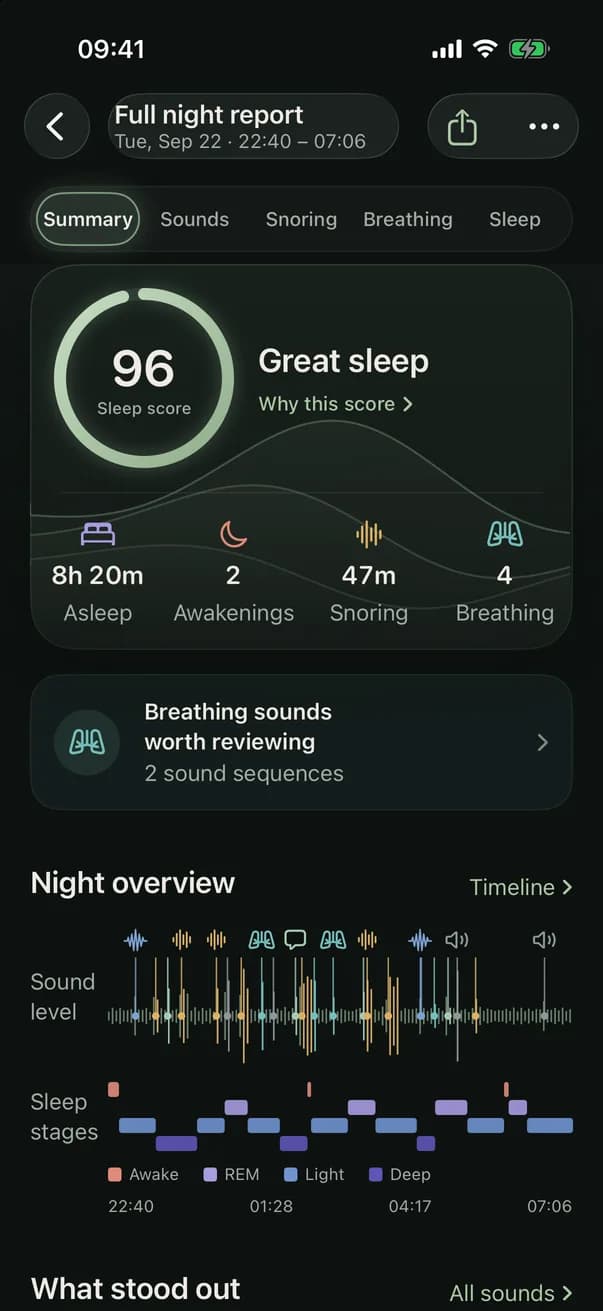
Snorezy puts your Apple Health sleep next to what the night sounded like, and lets you note what was different before bed. Trends then shows how your nights compare, with the number of nights behind every comparison.
Sources
- 1Edinger JD et al. Behavioral and psychological treatments for chronic insomnia disorder in adults: an American Academy of Sleep Medicine clinical practice guideline. J Clin Sleep Med. 2021;17(2):255-262.
- 2Watson NF et al. Recommended Amount of Sleep for a Healthy Adult: A Joint Consensus Statement of the American Academy of Sleep Medicine and Sleep Research Society. J Clin Sleep Med. 2015;11(6):591-592.
- 3Drake C et al. Caffeine effects on sleep taken 0, 3, or 6 hours before going to bed. J Clin Sleep Med. 2013;9(11):1195-1200.
- 4Ebrahim IO et al. Alcohol and sleep I: effects on normal sleep. Alcohol Clin Exp Res. 2013;37(4):539-549.
- 5Riedy SM, Smith MG, Rocha S, Basner M. Noise as a sleep aid: A systematic review. Sleep Med Rev. 2021;55:101385.