
Sleep apnea: what it is, the signs, and what to do
Obstructive sleep apnea (OSA) is when the walls of your throat relax and narrow or close while you sleep, interrupting your breathing [1]. Loud snoring, pauses in breathing that someone else notices, gasping, and feeling unrefreshed however long you sleep are the common signs [1]. It's diagnosed with a sleep test, and it's treatable.
Last reviewed 24 September 2026. General information from the Snorezy team, not medical advice.
Obstructive and central sleep apnea
Obstructive sleep apnea is by far the more common type, and it's what people usually mean. The airway physically narrows or closes [1]. Central sleep apnea is different: the airway stays open but the brain doesn't send the signal to breathe for a while. It's less common, it isn't typically marked by snoring, and it's a question for a doctor. This page is about OSA.
The signs
Signs of OSA listed by NHS inform [1]:
- snoring or snorting, often loud;
- pauses in breathing that someone else notices;
- choking or gasping during sleep;
- unrefreshing sleep, and feeling very sleepy or tired during the day;
- morning headaches;
- waking in the night to urinate;
- problems with memory or concentration.
The signs happen while you're asleep, so a partner often notices them first.
Who is more likely to have it
OSA is more common in people who [1]:
- are overweight;
- are male;
- are over 40;
- have a large neck, large tonsils or tongue, or a lower jaw set further back;
- have type 2 diabetes or a heart rhythm problem such as atrial fibrillation.
People without any of these can still have it.
How common it is
A 2019 study estimated that 936 million adults aged 30 to 69 worldwide have mild to severe OSA, and 425 million have moderate to severe OSA [2]. That's a modelled estimate built from 17 studies in 16 countries, and the study was funded by ResMed, a maker of CPAP machines [2]. Even allowing for that, it's a common condition.
Why it's worth finding out
Sleep apnea breaks up your sleep, often without you knowing. Separately, regularly getting too little sleep is associated with high blood pressure, heart disease, stroke, diabetes and depression [3]. The practical point is simple: if the signs above sound familiar, see a doctor. Diagnosis is straightforward and treatment works for many people.
What to do next
Talk to your doctor and describe what you and anyone who sleeps near you have noticed. They may arrange a sleep test: see how sleep apnea is diagnosed. If it's confirmed, there are several treatment options.
In Snorezy
What Snorezy can and can't do here
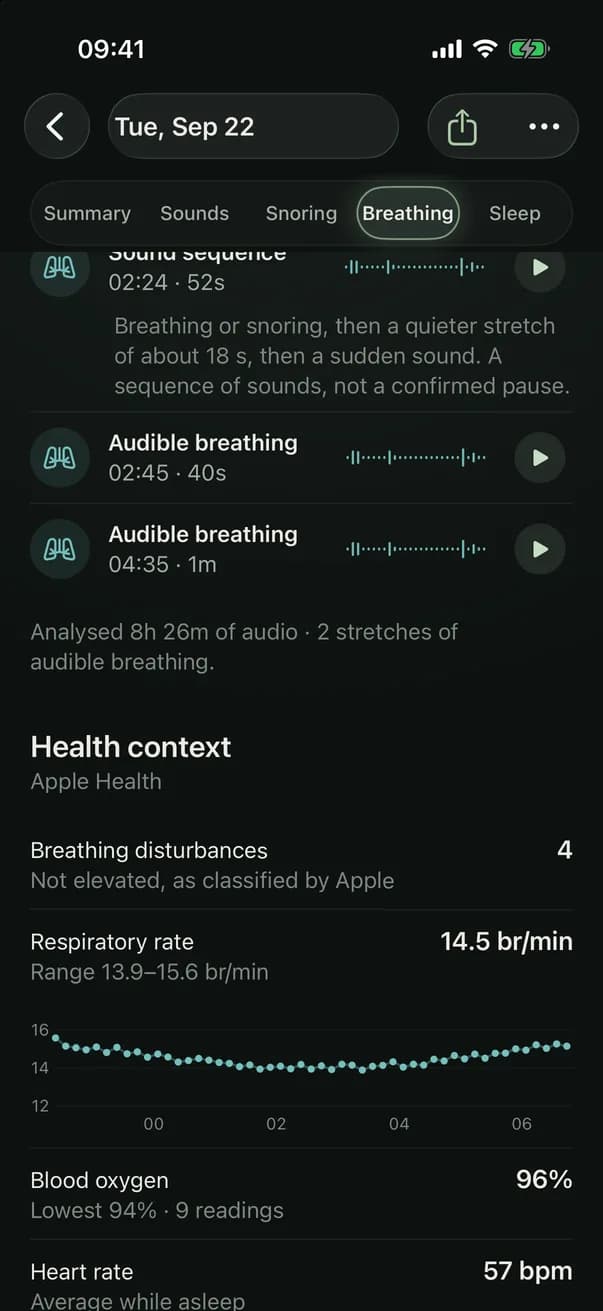
Snorezy can't diagnose sleep apnea, and it can't rule it out. What it can do is record the night and show you breathing-related sounds to review: gasp-like sounds, audible breathing, and sequences where snoring or breathing goes quiet and ends in a sudden sound, each kept with the minute before it. A clip you can play is often easier to bring to an appointment than a description.
Questions
Can you have sleep apnea without snoring?
Yes. Snoring is common in obstructive sleep apnea but not universal, and central sleep apnea isn't typically marked by snoring. Daytime sleepiness and witnessed pauses are signs too [1].
Is sleep apnea dangerous?
It breaks up sleep, and regularly getting too little sleep is associated with high blood pressure, heart disease, stroke and diabetes [3]. It is worth getting checked, and it is treatable.
Sources
- 1NHS inform. Obstructive sleep apnoea (OSA).
- 2Benjafield AV et al. Estimation of the global prevalence and burden of obstructive sleep apnoea: a literature-based analysis. Lancet Respir Med. 2019;7(8):687-698.A modelled estimate from 17 studies in 16 countries, funded by ResMed, which makes CPAP machines.
- 3Watson NF et al. Recommended Amount of Sleep for a Healthy Adult: A Joint Consensus Statement of the American Academy of Sleep Medicine and Sleep Research Society. J Clin Sleep Med. 2015;11(6):591-592.